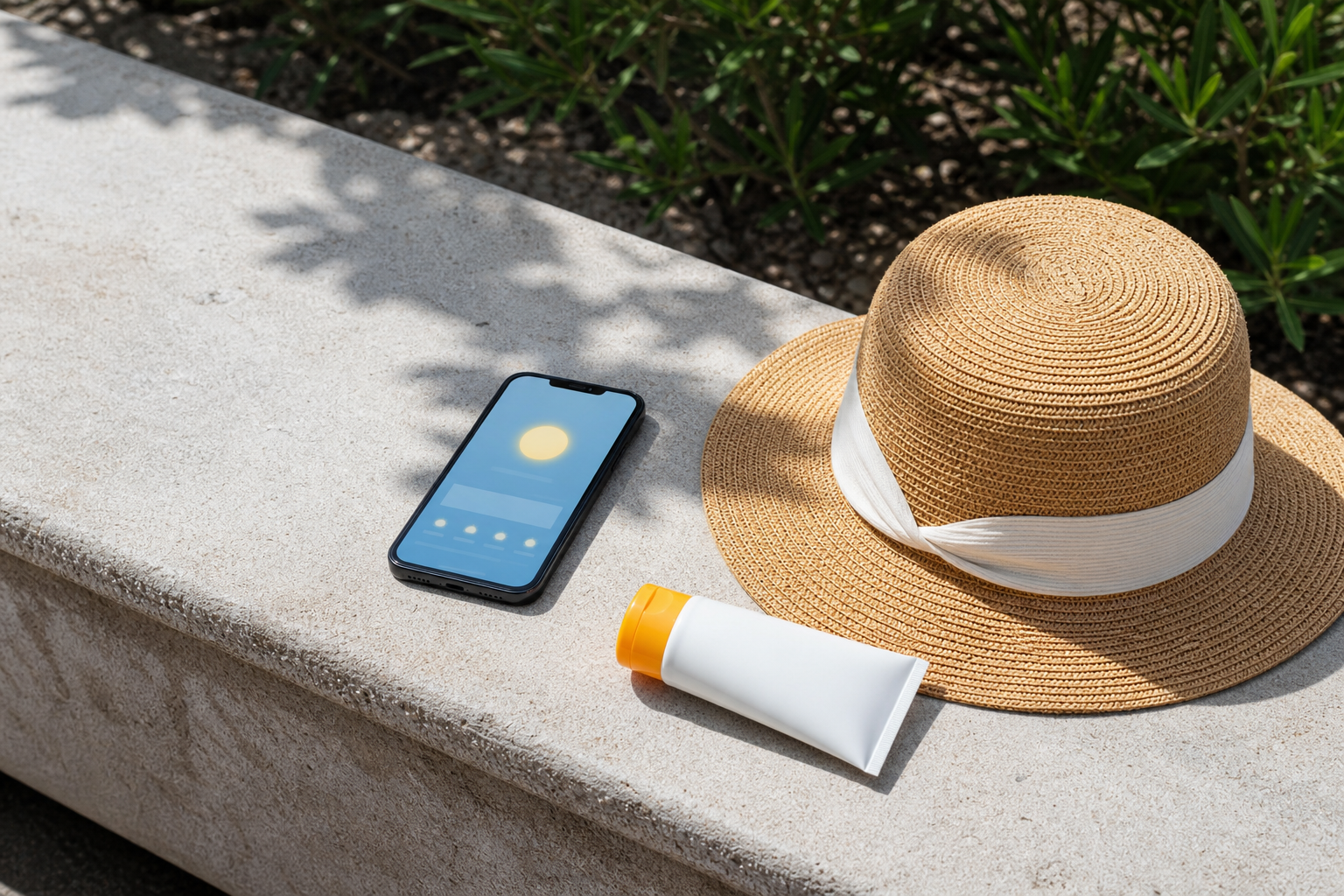
A hot day and a high-UV day often arrive together, but they are not the same thing. During a heatwave, temperature tells you about heat stress; the UV index helps you judge the strength of ultraviolet radiation. The two numbers belong in the same morning check, not in the same mental box.
The two numbers answer different questions
Temperature measures how warm the air is. UV index forecasts the strength of ultraviolet radiation at the surface. A cool, bright day can still have meaningful UV, while a very hot day can have changing UV depending on time, cloud, latitude, altitude and atmospheric conditions.
That is why “it does not feel hot” is a poor sunscreen test. Skin does not need to feel warm before UV becomes relevant. The reverse is also true: a heatwave plan needs more than sunscreen because shade, water, loose clothing and breaks matter for heat exposure even when the UV number is lower.
How to read the UV index before leaving home
Weather apps and official forecast services often show a daily peak or timeline. Look for the highest period rather than checking only the morning number. If your commute, school run, lunch walk or outdoor job overlaps with the peak, build the plan around that window.
For a normal day, the plan can be simple: apply sunscreen to exposed skin, add clothing and shade where practical, and keep the bottle where reapplication will happen. For an outdoor day, add a second decision after sweat, swimming, towel drying or rubbing from clothing and equipment.
Check the UV peak and the hours you will be outside.
Count uncovered skin, reflective surfaces and time without shade.
Plan for sweat, water, wiping and clothing rub.
Clouds, shade and reflected light still change the day
Cloud cover can reduce some incoming radiation, but it is not a reliable all-clear. The amount and type of cloud matters, and a forecast can change during the day. Shade reduces direct exposure but does not create a perfect bubble, especially near bright surfaces such as water, pale paving or sand.
Use shade as part of a layered plan rather than a reason to skip every other layer. A hat protects areas that are easy to miss with a hurried application. Sunglasses and clothing reduce the amount of exposed skin. Sunscreen fills gaps on the skin that remains uncovered.
A heatwave plan that survives a normal day
- Start with the forecast window. Note the UV peak and the hours you will actually be outside.
- Choose a wearable sunscreen. A finish that makes you use less is a practical mismatch.
- Cover forgotten edges. Ears, hairline, neck, backs of hands and tops of feet are commonly missed.
- Change the plan after water or sweat. Water resistance is a use-case clue, not an all-day promise.
- Carry a reapplication format. Put it where the decision happens, not at the bottom of a suitcase.
When temperature becomes the bigger problem
On an exceptionally hot day, sunscreen is only one part of the plan. Move activity away from the hottest period where possible, use shade, drink regularly and watch for symptoms of heat illness. SPF does not solve overheating.
Do not treat a cold day as an automatic reason to ignore the UV forecast either. Winter glare, outdoor sport, high altitude and long exposure can make the day different from the temperature alone. Our guide to winter daylight and office routines explains why routine decisions do not always follow the season.
What changes after swimming, exercise or wiping?
Reapplication is driven by what happened to the film on the skin, not just the clock. Water, sweat, towel drying, masks, collars and frequent hand washing can change coverage. If the day contains one of those events, make the next application part of the activity rather than waiting for a perfect time.
The amount still matters. Applying a thin symbolic layer to make the bottle last changes the protection described by the label. If the finish is uncomfortable at a usable amount, switch the format or texture instead of quietly reducing the amount.
Questions readers ask during hot weather
Do I need sunscreen on a cloudy heatwave day?
Use the UV index and exposed time to make the decision. Cloud can reduce radiation but does not make every outdoor day risk-free.
Is high temperature proof that UV is high?
No. Temperature and UV are different measurements. Check the UV forecast rather than using heat as a shortcut.
Does shade replace sunscreen?
Shade is valuable, but reflected and scattered light still reach exposed skin. Combine shade with clothing and sunscreen where appropriate.
How often should I reapply in a heatwave?
Reapply when sweat, water, wiping or clothing has reduced coverage, and follow the product directions. Outdoor days need more attention than a short indoor commute.
Reliable sources for the numbers
- Met Office: understanding UV levels
- Met Office: July 2026 heatwave update
- Cancer Research UK: sun safety
The practical conclusion: Start with the UV index, then add the day’s heat, clothing, shade, water and activity. That produces a better plan than using temperature as a proxy for sun exposure or expecting one application to survive every event.
Why the app and your skin can disagree
A forecast is a useful starting point, not a personal exposure meter. The app may report a daily peak for an open location while you spend most of the day beside buildings, under trees or in a car. The same forecast can feel different on a beach, a pale terrace or a sports field where there is little shade and more reflected light.
Activity changes the plan too. A ten-minute walk to a shaded office is not the same as a two-hour run, even if both happen at the same temperature. Sweat, wiping, helmets, straps and changing clothes can remove or disturb sunscreen. That is why the best heatwave routine is built around events, not just a number on the screen.
Use the forecast to make the first decision, then notice what the day does to the application. If the film has been rubbed away, do not wait for the next official forecast update. Reapply according to the product directions, move into shade and use clothing where practical. The point of the UV index is to improve the plan, not to replace attention.
Keep one simple note after a difficult day: when you applied, when the UV peak occurred, what activity changed the routine and which areas were missed. That record is more useful for tomorrow than a generic promise that one bottle works for every kind of summer day.
Timing also affects how comfortable the routine feels. Applying before clothes, bags and outdoor equipment touch the skin gives the product a chance to settle. If the morning is already rushed, simplify the layers underneath rather than reducing sunscreen to a token amount. A calm, repeatable sequence is easier to protect than an elaborate one.